
Across nursing education and practice, clinical judgment has re-emerged as a defining professional priority. In the United States, the implementation of the Next Generation NCLEX has intensified discussion of the topic, but the underlying challenge is international: nurses in every setting must interpret complex assessment data, make defensible clinical judgments, and connect those judgments to appropriate nursing diagnoses, interventions, and outcomes.
Although clinical judgment is often described as a broad cognitive competency, nursing requires greater clarity about its relationship to diagnostic reasoning and nursing diagnosis. From the perspective of the International Nursing Knowledge Association, or INKA (formerly NANDA International) a nursing diagnosis is a clinical judgment about a human response to health conditions or life processes, or a susceptibility to such a response. Nursing diagnoses provide the basis for selecting nursing interventions intended to achieve outcomes for which the nurse has accountability (Herdman et al., 2024). Nursing diagnosis therefore represents one of the most important outcomes of nursing clinical judgment.
The growing emphasis on clinical judgment creates an opportunity to reconsider the nursing process and clarify the relationships among clinical judgment, diagnostic reasoning, nursing diagnosis, intervention planning, and outcome evaluation. Understanding these relationships is essential for nursing educators, researchers, and clinicians seeking to improve diagnostic accuracy, strengthen evidence-informed care, and advance nursing practice across countries and healthcare settings.
Put simply:
Clinical judgment is the broader process. Diagnostic reasoning is the cognitive work within that process. Nursing diagnosis makes the resulting professional judgment visible.
Nursing Diagnosis as an Outcome of Clinical Judgment
A nursing diagnosis is far more than a label entered into a care plan or electronic health record. It represents the nurse’s evidence-informed interpretation of a patient’s response to a health condition or life process.
Through nursing diagnosis, the nurse communicates what the assessment findings mean from a nursing perspective and identifies the human responses that nursing care can address. This is what distinguishes nursing diagnosis from the simple collection or reporting of patient data.
Without an accurate diagnosis, nursing actions may be poorly targeted, desired outcomes may remain unclear, and evaluation may be disconnected from the patient’s actual needs. Nursing diagnosis therefore serves as a critical bridge between assessment and action.
It transforms clinical evidence into a professional judgment that can guide care.
The Nursing Process as Nursing’s Scientific Method
The renewed focus on clinical judgment also provides an opportunity to reconsider the nursing process.
Narayan (2025) argued that the nursing process should be understood as nursing’s scientific method because it provides a systematic framework for inquiry, problem-solving, action, and evaluation. Assessment produces clinical evidence. Diagnostic reasoning generates and tests possible explanations. Planning identifies goals and appropriate nursing actions. Implementation puts those decisions into practice, while evaluation determines whether the approach was effective or requires revision.
This perspective helps move nursing practice away from task completion and toward disciplined, reflective reasoning.
Relationship building, communication, observation, and critical thinking are not peripheral skills. They are essential methods through which nurses gather and interpret clinical evidence. A patient’s words, behaviors, functional abilities, environment, concerns, values, and responses to treatment all contribute to the diagnostic process.
Although some terminology associated with the nursing process may continue to generate debate, the central principle is difficult to dispute: professional nursing practice requires a systematic method for transforming observations into judgments, judgments into actions, and actions into measurable outcomes.
How the NCJMM Connects to Diagnostic Reasoning
One useful framework for examining how nurses think in complex clinical situations is the National Council of State Boards of Nursing’s Clinical Judgment Measurement Model, or NCJMM. Although the model was developed within the context of nursing regulation and licensure in the United States, the reasoning activities it describes are relevant to nursing education and practice internationally.
Within the model, nurses recognize cues, analyze cues, prioritize hypotheses, generate solutions, take action, and evaluate outcomes (Dickison et al., 2019).
These activities should not be viewed as an abstract sequence that exists separately from nursing diagnosis. Nursing diagnosis gives professional form to much of the reasoning occurring within the model.
When nurses recognize cues, they identify relevant assessment findings. These may include signs, symptoms, behaviors, laboratory results, patient statements, functional changes, environmental influences, defining characteristics, and risk factors.
When nurses analyze cues, they cluster related information and determine whether a meaningful pattern is emerging. At this stage, possible nursing diagnostic hypotheses begin to take shape.
When nurses prioritize hypotheses, they compare alternative explanations, examine how strongly each is supported by the available data, and determine which potential nursing diagnoses are most clinically relevant.
When nurses generate solutions, they confirm the priority diagnosis, establish patient-centered goals, identify appropriate outcome indicators, and select evidence-informed nursing actions.
When nurses take action, they implement the plan while continuing to observe the patient and gather new evidence.
When nurses evaluate outcomes, they determine whether the expected goals have been achieved and whether the diagnosis and plan of care should be maintained, refined, or revised.
The NCJMM therefore describes much of how nurses think, while standardized nursing diagnoses communicate the professional judgments that result from that thinking.
From Clinical Evidence to Measurable Outcomes
NANDA 360 helps operationalize the relationship among clinical judgment, diagnostic reasoning, nursing diagnosis, planning, intervention, and evaluation. It connects assessment-based nursing diagnoses with patient goals, outcome indicators, nursing actions, and outcome measurement.
Table 1: Relationship Among Clinical Judgment, Diagnostic Reasoning, and NANDA 360
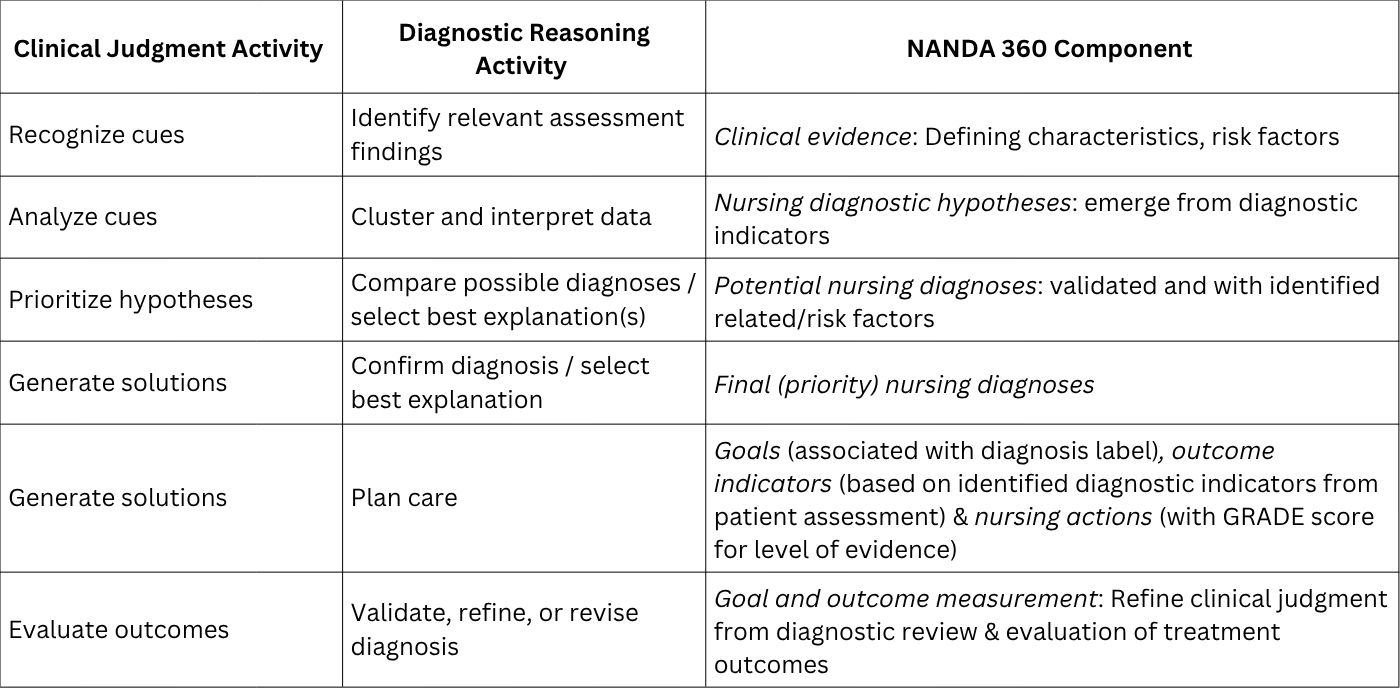
This alignment is important because diagnosis should not be separated from care planning or outcome evaluation.
Once an accurate, assessment-driven diagnosis has been established, NANDA 360 supports the nurse in identifying an appropriate patient goal, selecting relevant outcome indicators, choosing evidence-informed nursing actions, and evaluating outcomes directly connected to the individual patient’s assessment data.
The result is a coherent and traceable line of reasoning:
Assessment findings lead to diagnostic indicators. Diagnostic indicators support a nursing diagnosis. The diagnosis guides patient goals and nursing actions. Patient outcomes then provide evidence for validating or revising the diagnosis and plan of care.
In this way, NANDA 360 operationalizes the nursing process by bringing clinical judgment, nursing diagnosis, patient goals, nursing actions, and patient outcomes together within a unified classification.
In Part 2, coming in early August, we will explore what these relationships mean for nursing education, including how nursing diagnosis can be taught as a reasoning competency, the role and limits of the three-part diagnostic statement, and the learning strategies that can strengthen clinical judgment and diagnostic reasoning.
References
Daneshfar, M., & Moonaghi, H. K. (2025). The impact of clinical simulation on bridging the theory–practice gap in nursing education: A systematic review. BMC Medical Education, 25(1), Article 1216. https://doi.org/10.1186/s12909-025-07790-8
Dickison, P., Haerling, K. A., & Lasater, K. (2019). Integrating the National Council of State Boards of Nursing Clinical Judgment Model into nursing educational frameworks. Journal of Nursing Education, 58(2), 72–78. https://doi.org/10.3928/01484834-20190122-03
Herdman, T. H., Kamitsuru, S., & Lopes, C. T. (Eds.). (2024). NANDA International nursing diagnoses: Definitions and classification, 2024–2026 (13th ed.). Thieme.
Liu, W. (2024). Development of clinical decision-making among undergraduate nursing students: The effect of unfolding case-based learning. International Journal of Nursing Education Scholarship, 21(1), Article 20230115. https://doi.org/10.1515/ijnes-2023-0115
Narayan, M. C. (2025). Nursing’s scientific method: Thinking critically about the nursing process. AJN, American Journal of Nursing, 125(10), 52–57. https://doi.org/10.1097/AJN.0000000000000167
Obeagu, G. U., & Muhammad, T. (2025). Impact of case-based learning on critical thinking in clinical decision-making among student nurses of Kampala International University, Uganda. Advances in Medical Education and Practice, 16, 1861–1868. https://doi.org/10.2147/AMEP.S547292
About the Author
Dr. T. Heather Herdman, RN, PhD, FNI, FAAN, is Chief Executive Officer of the International Nursing Knowledge Association (INKA), formerly NANDA International (NANDA-I). She is a former President of the Association and has served as a member, Chair, Director, and Co-Director of the Diagnosis Review Committee and Diagnosis Development Committee. Since 2009, she has served as editor or co-editor of NANDA International Nursing Diagnoses: Definitions and Classification. A member of the founding class of NANDA-I Fellows and recipient of the NANDA-I Mentor Award, Dr. Herdman is also a Fellow of the American Academy of Nursing. Her clinical and research expertise spans clinical reasoning, nursing diagnosis, neonatal and high-risk perinatal care, women’s health, spirituality, and integrative health care.
Comments (0)
Leave a comment