
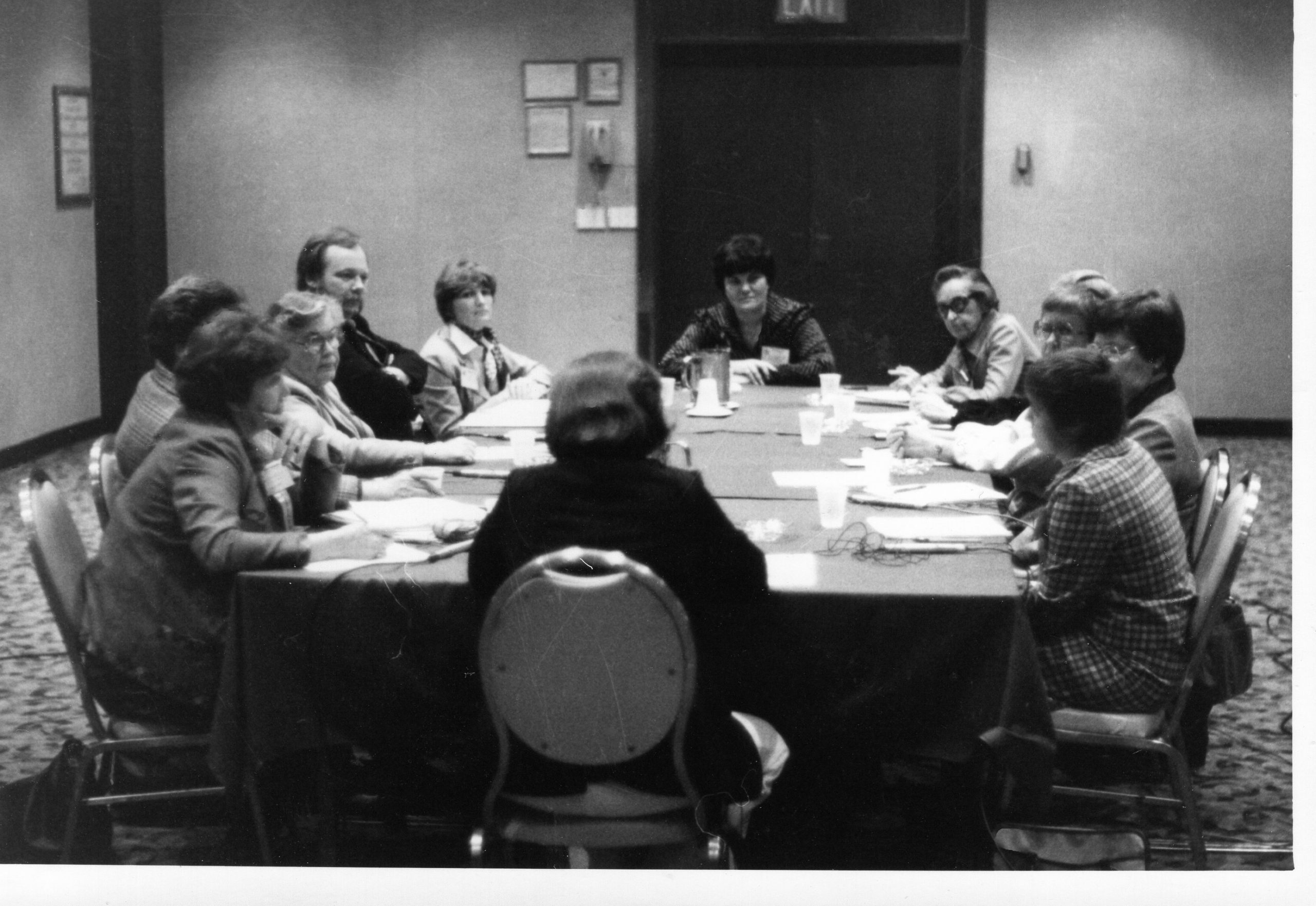
On a semi-regular basis, the blog will feature highlights from the NANDA Archives at Boston College’s Burns Library. Visiting these documents allows us to reconnect with the scholars and practitioners whose work informed the foundations of NANDA-I. As NANDA-I continues to evolve, the Archives can help us root our language in its origins.
This month, we are highlighting a publication written by Dr. Marjory Gordon (September, 1998) and connecting it to an unpublished report from the Taxonomy Committee to the NANDA Board (August, 1998). All images and quotations from the report can be found at the Burns Library with the following citation: NANDA-I records, MS.1998.006, Taxonomy Committee Report, 1998, 12/16.
In Nursing Nomenclature and Classification Development (September, 1998), Gordon discussed the evolution of nursing taxonomy, languages, and classifications to that point.
“The current North American classification. . . was nurtured through the efforts of NANDA Taxonomy Committee chairpersons, Drs. Phyllis Kritek, Joyce Fitzpatrick, and currently Kay Avant. Models and frameworks (Maslow, Abdellah) for organizing nursing diagnoses were suggested by participants at the First National Conference and later (Lunney, 1984; Loomis, 1987).”
Gordon discussed NANDA-I’s commitment to centering nurses and the organization’s commitment to rooting their systems, language, and decisions in the evolving science of Nursing. In this publication, Gordon highlighted the processes that informed the creation of Taxonomy I.
“NANDA currently classifies nursing diagnoses into Taxonomy I, Revised using the structure of Human Response Patterns, [which] was accepted by participants in 1986 at the Seventh Conference. In 1998, the Taxonomy Committee. . .explored other typologies for organizing diagnoses that may be more useful. . . Comments and suggestions will be elicited from the profession prior to the Taxonomy Committee’s report to the Fourteenth NANDA Conference in 2000. Similar to diagnosis review, taxonomy review is based on the philosophy that all nurses should have an opportunity to participate in the development of a classification system for the profession.”
Gordon specifically addressed the ongoing efforts of the Taxonomy Committee that would inform Taxonomy II. Committee reports are included in the NANDA Archives at Boston College.
In August of 1998, Dr. Kay Avant shared a report from the Taxonomy Committee that describes the ongoing work that Gordon referenced. Photos of the complete report are included below. Avant’s report highlights NANDA’s commitment to scientific rigor and member participation. For example:
“During the April [1998] meeting, the taxonomy committee conducted a Q-sort study and invited conference participants to come by and sort diagnoses in the proposed new domains and classes. . . We wish to thank them publically [sic] for their help. It took an average of 45 minutes to an hour to complete the sorts and we are very grateful for their willingness to help us with this work.”
Avant shared specifics regarding the methods the committee used in this process:
“Twenty-five persons participated in the Q-sort exercise with Taxonomy 2 domains and classes. They had available both the domain definitions and the taxonomy book so they could look up definitions of diagnoses if they needed them. Members of the taxonomy committee were present at all times during the Q-sorts to answer questions, etc. The comments we received from participants were generally favorable toward the new taxonomy. Many who took part in the Q-sort commented that the work was harder than they expected it to be! We have completed the preliminary analysis of the data from the Q-sort and the committee is currently reviewing the results. The next step we need to complete is the Delphi study we proposed at the conference.”
Understanding the processes of nursing- the how and why of the work we do- is crucial to become a successful practitioner, educator, researcher, and student. When we can contextualize these processes, we gain further understanding of the art and science of nursing. As we work towards the launch of NANDA 360, it can be useful to reflect upon earlier NANDA-I initiatives, such as Taxonomy I and II, which serve as the foundations upon which NANDA 360 was constructed.
Report Of The Taxonomy Committee To The NANDA Board August, 1998
Comments (0)
Leave a comment