

For more than a decade, we have listened closely to nurses, educators, informaticians, and leaders as they shared their frustrations, such as mapping and interoperability challenges, training, and academic integration gaps. NANDA 360 grew directly from those conversations: a unified, evidence-based framework and expanded classification that strengthens diagnostic reasoning, supports individualized care, and makes nursing’s contribution more visible in practice and in decisions.
Why We Created NANDA 360
Across the globe, nurses face growing demands with tools and systems that don’t fully support their expertise. Knowledge is fragmented, resources are unevenly accessible, while many EHRs (electronic health records) work around, rather than alongside, the nursing process. These aren’t new complaints; we’ve heard them for years from clinicians, educators, informaticians, and leaders. However, the result is more than frustration: it slows evidence development, reduces comparability across sites, and places extra burden on an already stretched workforce.
What we hear consistently
- Academic integration gaps
Many faculty struggle to integrate SNL (standardized nursing language) across curricula, defaulting to medical terminology because supporting educational materials are limited.
Commercial trainings that “teach NANDA-I” are sometimes inaccurate, leading to contradictions with our official publications and confusion for students.
- Mapping and interoperability challenges
Ineffective or proprietary mappings between multiple classifications are uneven in quality and validity.
“Imperfect fit” is the norm: linkages between diagnosis, intervention, and outcome should include consideration of patient context, resources, and clinical judgment. That nuance is often lost in rigid implementations.
- Training and change-management gaps
Without proper preparation, common errors recur (e.g. making direct connections from a medical condition to a nursing diagnosis without considering patient assessment data).
Day-to-day use of SNLs is inconsistent, revealing a gap between theory and practice.
- Access barriers
In some regions, it’s hard to obtain the NANDA-I book in local languages; there are delays between the English edition and translations, and piracy/poor unauthorized translations persist.
- Unlicensed use and fragmentation
We’re frequently shown examples of unlicensed use of NANDA-I content in EHRs, often hand-entered, incomplete, and inappropriately linked to medical conditions instead of nursing assessment.
Some organizations avoid classifications entirely due to complexity, cost, or poor fit with current systems.
- Documentation burden
Some EHRs push one-size-fits-all, prebuilt care plans that don’t reflect the patient’s reality or the nurse’s reasoning.
- System misfit and cost
Many EHRs were not designed around nursing terminologies; integrations can feel clumsy, recipe-driven, and hard to maintain.
Full, standards-based configuration (including assessment linkages and cross-terminology updates) requires time, investment, and expertise, and those mappings need ongoing updates as classifications evolve.
- Risk to individualized care
Over-automation or premade care plans can push “cookbook” nursing, overshadowing patient-centered language and the nurse’s professional judgment.
What nurses and leaders consistently asked us for was
A comprehensive system that supports clinical reasoning and incorporates the best evidence, while allowing nurses to customize the plan for individual patient responses/ desires/ circumstances.
Our response was NANDA 360: an Integrated Nursing Knowledge Base …
But the decision to create an Integrated Knowledge Base such as this was not made lightly. For many years, we resisted developing such a solution out of respect for our close collaboration with other nursing terminologies.
How We Got Here: The Journey Since 2022
Fragmented systems, documentation burdens, and unequal access pointed to a simple truth: nurses needed a unified, evidence-based solution that strengthens reasoning, supports individualized care, and makes nursing’s full value visible. NANDA 360 was born from the challenges nurses and healthcare leaders have voiced for decades, yet the process to get to this point has taken several years of careful deliberation and research.
Diagnosis at the Center: Then and Now
Everything began with, and keeps returning to, diagnosis.
We started by tackling the critical link between assessment → diagnosis, with the intent to develop a comprehensive nursing assessment based on Functional Health Patterns. However, after a year of work – and feedback from others – we recognized that adopting a single assessment model might unintentionally restrict its applicability across diverse practice contexts. Therefore, we decided not to impose a specific framework, but to align our approach with the variety of assessment processes already in use in different care settings, ensuring integration with current nursing practice. We built a tool to guide a novice considering a plan of care which could improve their clinical and diagnostic reasoning, and to support an expert in confirming clinical reasoning.
Yet, we also heard something else, again and again: diagnosis is central, yet nurses also need a coherent path forward from diagnosis to outcomes, goals, and actions, that still prioritizes individualized care. As we engaged with nurses, educators, informaticians, and leaders, they pushed us, and rightly so, to think bigger. After all, a system that only supports diagnostic accuracy isn’t enough in modern practice. And so, after careful deliberation, in 2025 we committed to building a comprehensive classification and reasoning framework that keeps diagnosis central while enabling evidence-based linkages across the entire nursing process.
Thus, we extended our own NANDA-I diagnosis work and built original, evidence-linked pathways from diagnosis → outcomes/goals → actions.
To connect diagnoses → outcomes/goals → actions, we committed to a grounds up, evidence-based development of this expanded classification, conceived around the NANDA-I taxonomy. We reviewed the scientific literature and prioritized the strongest available evidence for each action within the specific diagnosis + related/risk-factor context. Systematic reviews and meta-analyses were preferred; when more applicable or more recent, we used randomized trials, quasi-experimental and observational studies, and qualitative syntheses (for mechanisms, acceptability, implementation). Each action received an evidence level based on the highest GRADE rating directly supporting that action–related/risk-factor pairing. If no factor-specific evidence was found, the action was excluded or downgraded. This approach keeps the linkages transparent, citable, teachable – and updatable as new evidence emerges.
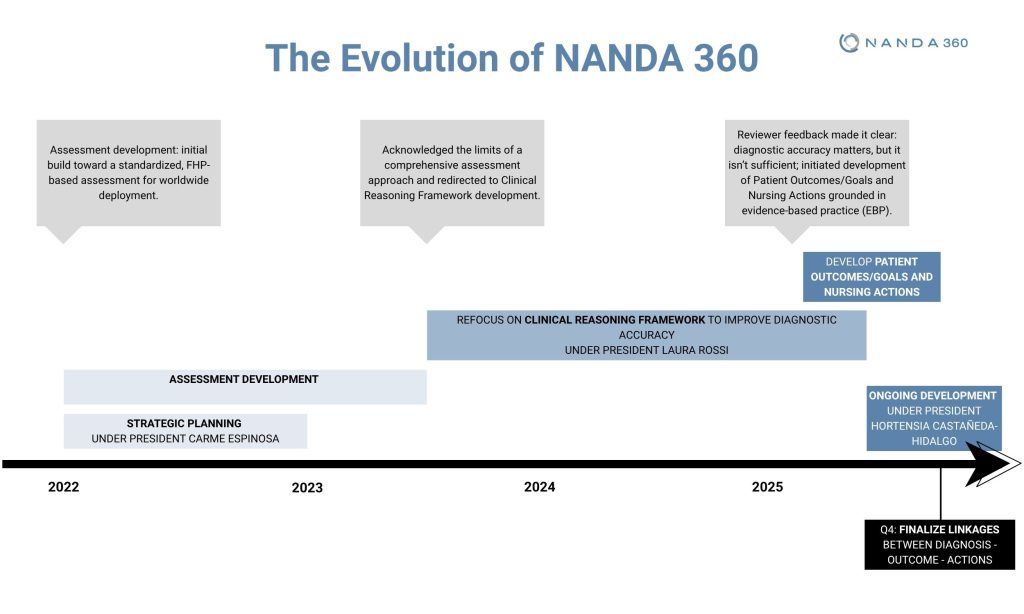
From there, we have continued to build out the expanded classification and framework, with the goal of finalizing the linkages* by the end of Q4 of 2025.
Looking back over the past four years, the path was inevitable and necessary: while diagnosis remains the anchor, the clinical reasoning framework and expanded classification now carry nurses’ judgments forward in an evidence-based way, linking diagnosis to evidence-based outcomes and goals, and actions, so planning becomes both efficient and clinically meaningful. Plus, the complete system delivers elegant solutions to the original problems facing the profession.
NANDA 360 was built on the following principles
Unify the process in one expanded classification and clinical reasoning framework: assessment → diagnosis → outcomes/goals → actions.
Support the nurse’s clinical reasoning: support judgment without replacing it; preserve autonomy.
*Make linkages explicit: diagnoses – outcomes – goals – actions tied to evidence levels and context.
Interoperable and flexible by design: Can integrate with EHRs to reduce duplicate entry and improve comparability. Additionally, the expanded classification can be used on its own in situations where there is no EHR. Web-based clinical reasoning framework is also modular, so it can be used on its own with our extended classification, or with other standardized nursing terminologies**, depending on the requirements of the context of care.
Elevate the nurse’s voice: ensure reasoning is visible in the chart, across teams, and up to leadership. Nursing data can also be plugged into our standardized framework to support clinical research.
Protect individualization: not a one-size fits all care plan but a dynamic and responsive process that takes into account patient and care context, available resources, and patient and family priorities.
Sustainability & Accessibility: Unified licensing and staged rollout options to lower setup complexity and cost. Multilingual. Plan for maintainable mappings and coordinated releases. Modular format for the classification, so it can be used with other standardized nursing terminologies** if desired.
Education first: provide training and support so practice matches theory.
** NANDA 360 interoperates with other terminologies by design. It does not replicate, copy , rebrand or redistribute third-party content.
Thus, NANDA 360 in its fullness is a natural and necessary evolution of the work of this Association, work that we are proud to say we believe will strengthen the discipline.
The journey over these past four years has been careful and measured, yet with rapid iterative cycles as we responded to review and feedback, and has necessitated a small, accountable working group, not to exclude voices, but to safeguard the integrity of the work while the foundations were being set. A focused team allowed us to iterate quickly, protect our intellectual property, prevent incomplete versions from circulating, and shield the process from vendor pressure, politics, and “design-by-committee” drift. While we are an Association, and we deeply value member contributions, the Board of Directors is charged with strategic planning. That responsibility sometimes requires limited, confidential phases to set direction, establish guardrails, and ensure coherence before opening broad participation. That’s where we are now: moving from careful stewardship to broad engagement, with clear artifacts (guidance, training, timelines) so contributions strengthen the whole rather than fragment it. Now that the framework and classification have reached a more reliable stability, with diagnosis anchored, linkages* validated, and governance in place, we are widening the circle, by design.
We will always be an Association that values the voices of all its members, which is why we invite you now to join this next phase: to review, challenge, contribute to, and help us shape NANDA 360 together.
Comments (0)
Leave a comment