Login Cart

Use and Licensing

Cart Login Join INKA

Overview

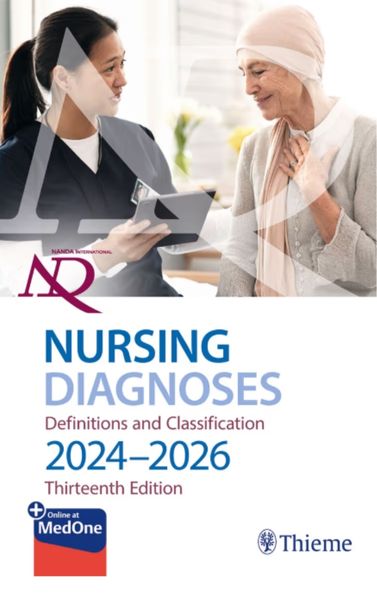
NANDA® International Nursing Diagnoses: Definitions & Classification is the official reference for nursing diagnoses, reviewed and approved through INKA’s (formerly NANDA International, NANDA-I) diagnosis development process. The book supports nursing practice by providing a standardized structure for identifying and documenting human responses to health conditions and life processes.

This page highlights how the book is used across practice, education, research, policy, and informatics, and outlines key considerations for permissions, licensing, and responsible use.


How This Book Is Used

nurse helping patient

Nurses in Practice

In clinical settings, standardized nursing diagnoses support assessment-driven, diagnosis-centered clinical reasoning and consistent documentation. Using a shared classification helps nurses:

  • identify clinical priorities based on assessment
  • communicate nursing judgment clearly across care teams
  • strengthen continuity of care across shifts and transitions
  • support care planning and evaluation

Standardized nursing diagnoses also strengthen the visibility of nursing contributions within interdisciplinary environments by making nursing judgments more consistent and measurable.

nurse educating students

Nurses in Education

In nursing education, the book provides a structured foundation for teaching assessment, clinical reasoning, and professional judgment. Educators use the classification to support:

  • case-based learning and simulation
  • consistent curriculum language and evaluation
  • student development of diagnostic reasoning skills
  • teaching the nursing process as a professional discipline

The classification helps students learn how to interpret assessment data and translate findings into clear diagnostic statements.

nurse on computer

Nurses in Research

In research, standardized nursing diagnoses support consistent measurement and comparison across settings, populations, and countries. The book supports:

  • validation and refinement of nursing diagnoses
  • research on human responses and nursing phenomena
  • study of diagnostic accuracy and clinical reasoning
  • classification-based inquiry that strengthens nursing science

Using shared diagnostic language strengthens the ability to build evidence across diverse clinical contexts.

nurse speaking to group

Nurses in Public Policy and Health Systems

For policy leaders and nursing administrators, standardized nursing diagnoses strengthen the visibility of nursing priorities in health systems. Nursing diagnoses support clearer representation of nursing contributions within quality and safety initiatives, workforce planning, and population health strategies.

Standardized nursing classifications help ensure that nursing’s professional scope is represented consistently across healthcare environments.

nurse on computer

Informatics and Electronic Health Records (EHRs)

In informatics and electronic health record implementation, standardized nursing diagnoses support structured documentation and interoperable nursing data. When implemented appropriately, they strengthen the visibility of nursing judgment in digital systems and support analysis of nursing contributions to outcomes, safety, and quality.

EHR integration may require mapping and governance processes and typically requires formal

Licensing, Permissions, and Responsible Use

INKA supports the appropriate use of standardized nursing knowledge in education, practice, and health systems. However, the content of NANDA International Nursing Diagnoses: Definitions & Classification is protected intellectual property.

Ownership of Content

The Terms of Use specify that content made available through INKA includes nursing diagnoses, definitions, taxonomies, classifications, explanatory text, tables, graphics, digital products, downloadable materials, and related documentation. This content is protected by United States and international copyright laws, database rights, and other applicable intellectual property laws.

Unless expressly permitted under the Terms or pursuant to a written license agreement, no rights are granted to use, reproduce, distribute, modify, adapt, translate, or create derivative works from this content.

Trademark Protection (NANDA® Name and Brand)

NANDA is a registered trademark of NANDA International, Inc. (now INKA)

The NANDA name, related logos, word marks, and brand identifiers are protected under United States and international trademark laws.

Use of the NANDA mark is strictly limited to identifying NANDA International, Inc. (now INKA) as the source of its goods and services. The NANDA mark may not be used in any manner that:

  • implies endorsement, sponsorship, or affiliation without authorization
  •  suggests that INKA approves of or is responsible for third-party content, products, or services
  •  incorporates the mark into product names, service names, titles, branding, or domain names
  •  creates a likelihood of confusion regarding origin, ownership, or association

Commercial or promotional use of the NANDA mark requires prior written permission.

Trademark protection applies independently of copyright protection for the book’s content.

When Permission or Licensing May Be Required

Permission or licensing may be required if you intend to:

  • reproduce, publish, distribute, or publicly display content
  • translate, adapt, modify, or create derivative works
  • incorporate content into software, applications, databases, academic platforms, electronic health records, decision-support tools, or other digital systems
  • upload or redistribute content on third-party websites, repositories, or platforms

Licensing requirements depend on the nature, scale, and purpose of the use.

Scholarly Reference and Fair Use

INKA recognizes that limited quotation or reference may be permissible in some contexts for scholarly research, academic commentary, criticism, teaching, or citation, where use is non-systematic and does not reproduce substantial portions of the content or substitute for the original work.

Prohibition on Text Mining and Data Extraction

INKA’s Terms of Use prohibit automated or manual text mining, scraping, data extraction, indexing, or systematic retrieval of content for the purpose of reproduction, redistribution, analysis, training machine learning or artificial intelligence models, or creating derivative works, unless explicit written authorization has been obtained.

Attribution Requirements

Where reference is expressly permitted, proper attribution acknowledging INKA as the source is required. Attribution does not grant permission to reproduce or reuse content beyond what is permitted under applicable law or an express written license.

Commercial Use

Commercial use of the content is not permitted without a formal written licensing agreement. This includes incorporation into software products, electronic health records, clinical or educational platforms, publications, training programs, assessment tools, or monetized services.

Permissions and Licensing Requests

For permissions and licensing inquiries, please contact: admin@nanda.org

You may also submit a request through Contact Us.

NANDA-I Nursing Diagnoses: Definitions and Classification

Where to Get the Book

To access the current nursing diagnosis classification, explore:

NANDA International Nursing Diagnoses: Definitions & Classification