Login Cart

Nursing Assessments

Full Nursing Assessments

Cart Login Join INKA

Nursing Assessments (From Assessment to Diagnosis)

Definition and Importance

Assessment is the foundation of nursing practice. It supplies the raw observations, measurements, and patient reports nurses need to make clinical judgments about human responses to health conditions and life processes. Moving from assessment to diagnosis is an iterative process: nurses collect data, interpret and cluster findings into meaningful patterns, generate diagnostic hypotheses, validate or refute them, and then prioritize and document diagnoses that guide care.

This process can proceed in a stepwise fashion in some cases, but often requires a back-and-forth movement between steps as more data are identified, leading to additional questions or the need to obtain different data. Hypotheses are challenged, refuted, and sometimes the process must begin again. The nurse’s ability to build rapport with the patient, family, or group is critical to obtaining a comprehensive assessment.

INKA (formerly NANDA® International, NANDA-I) emphasizes assessment because accurate nursing diagnoses depend on accurate, meaningful, and complete nursing data.


Clinical and Operational Relevance

A good assessment does more than record facts, it reveals how patients experience health, illness, and life changes. Nurses assess to identify problems, risks, and strengths; to build therapeutic relationships; and to gather the evidence needed to formulate nursing diagnoses.

Nursing assessment differs from medical assessment because it gives equal weight to:

  • Subjective data (patient experience)
  • Objective data (observed signs, measurements, and tests)

This helps nurses focus on how human beings respond to levels of wellness, life processes, and disease/injury, not the disease/injury itself. Understanding the purpose of assessment helps nurses resist the temptation to “select” a diagnosis without sufficient data and ensures care plans reflect individual patients’ actual needs and goals.

nurse educating students

Standards and Evidence Context

How Nurses Move from Assessment to Diagnosis

Moving from assessment to diagnosis is an evidence-based cycle that blends technical skill, conceptual knowledge, and patient partnership. Nurses gather data, interpret it through clinical reasoning, and use standardized nursing diagnosis concepts to validate their judgments.

This process is strengthened by:

  • Structured assessment frameworks
  • Standardized nursing diagnosis definitions and indicators
  • Reliable and valid clinical instruments (when available)
  • Ongoing reassessment and refinement

Screening Assessment and Moving to Deeper Inquiry

Screening assessments are short, standardized evaluations used early in care (for example, on admission or at a clinic visit). Their job is two-fold:

  1. To identify clusters of signs and symptoms (defining characteristics) that can be used heuristically to support fast, intuitive, pattern-based interpretation of the presence of a nursing diagnosis, enabling rapid decision-making in time-sensitive settings such as urgent and emergency care
  2. To identify people who need full, in-depth assessments

Screening typically includes vital signs, basic system checks, and risk tools (falls, pressure injuries, etc.). While screening is efficient, it is only the first step: any red flags or abnormal responses should trigger further targeted data collection. In short, screening tells you where to look more closely.

Obtaining Subjective Data (What the Patient Tells You)

Subjective data come from the patient (or family) and include feelings, perceptions, beliefs, and reports of symptoms. These data are essential for diagnosing many nursing concerns, especially those related to comfort, coping, and mental or emotional states.

Collect subjective data using open-ended questions, active listening, and empathy. When the patient cannot report for themselves, document the source of surrogate information and its limitations. Subjective and objective data together form the evidence base for sound clinical reasoning.

Obtaining Objective Data (What You Observe and Measure)

Objective data are the measurable or observable facts gathered through physical exam, vital signs, imaging tests, labs, and use of all senses (sight, touch, hearing, smell). Accurate objective assessment requires practical skill, the ability to perform focused physical exams, use monitoring equipment correctly, and interpret diagnostic tests.

Objective data confirm, nuance, or sometimes contradict subjective reports. Both types of data are necessary for a complete picture.

Using a Structured Assessment Framework: Gordon’s Functional Health Patterns

Frameworks help nurses organize a large volume of information. INKA recommends using an evidence-based framework such as Gordon’s Functional Health Patterns (FHP).

The FHP groups assessment into 11 patterns:

  • Health perception/management
  • Nutrition
  • Elimination
  • Activity-exercise
  • Sleep-rest
  • Cognition/perception
  • Self-concept
  • Role/relationships
  • Sexuality/reproduction
  • Coping/stress tolerance
  • Value/belief

Start by gathering broad pattern data (health perception) and progress to more personal areas (self-concept, values) once trust is established. The framework clarifies which areas need screening and where in-depth assessment is required.

Data Analysis and Clustering: Seeing Patterns

Collected data are raw until nurses apply conceptual knowledge to interpret them. Data analysis transforms measurements and observations into meaningful information (for example, converting height/weight to BMI and interpreting a BMI of 18.4 as underweight).


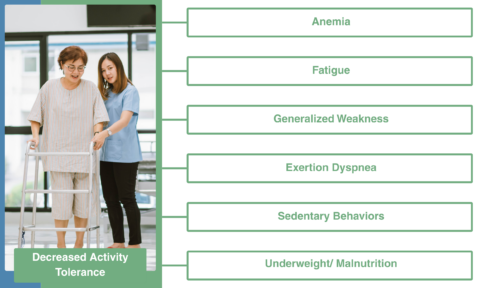
Clustering then groups related information. For example:

fatigue + exertional dyspnea + decreased activity

→ a pattern suggesting decreased activity tolerance

Good clustering lets the nurse “see the picture” and is the cognitive bridge to diagnostic hypotheses.

Generating and Testing Diagnostic Hypotheses

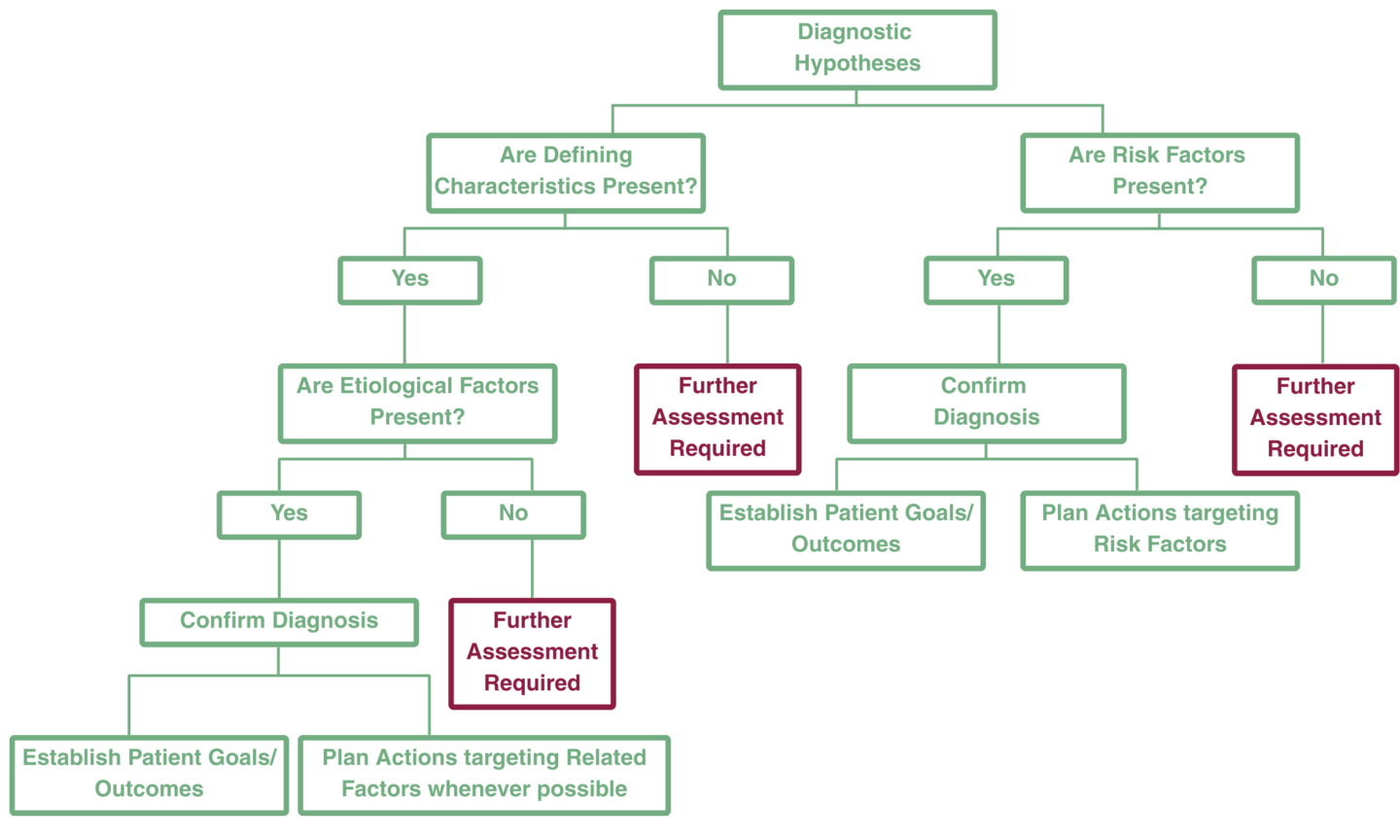
From clustered information, nurses identify plausible nursing diagnoses (diagnostic hypotheses). These hypotheses are then tested by comparing assessment findings with standardized definitions and diagnostic indicators (defining characteristics, related factors, risk factors) identified by INKA.

Avoid inventing terms at the bedside. Use standardized labels when they match the patient’s pattern, or document the problem clearly if no label matches what you are identifying.

Using validated, reliable instruments (pain scales, dyspnea inventories, fatigue scales) strengthens the evidence that supports or refutes a hypothesis.

Differentiating Similar Diagnoses and Prioritizing Care

Some nursing diagnoses share similar defining characteristics and must be distinguished carefully. Useful strategies include:

  • Checking taxonomy location (domain and class)
  • Comparing precise definitions
  • Considering how necessary and specific defining characteristics are
  • Identifying the cause (or risk factors for) the diagnosis
  • Choosing the more specific diagnosis when it best fits the data

Once the appropriate diagnoses are chosen, prioritize them. Prioritization rests on:

  • Urgency (life-threatening issues first)
  • Interactions between diagnoses (treat root causes that worsen others)
  • Patient preferences
  • Practical frameworks such as Maslow’s hierarchy (physiological needs take precedence over psychosocial concerns in acute settings)

The highest-priority diagnosis guides immediate interventions and planning. It is important to remember that a risk diagnosis could be the highest priority diagnosis when it represents imminent harm.

From Documentation to Evaluation

In educational settings, a three-part documentation format (Diagnosis label – related to- (related or risk factors) as evidenced by (defining characteristics) demonstrates reasoning and is useful for teaching. In practice, the diagnosis label plus supporting assessment notes already in the patient record is sufficient. Documentation should reflect both the diagnosis and the data that justify it. In other words, INKA does not require or support the 3-part-statement for documentation in clinical practice; we do support it for educational purposes.

Within the nurse’s assessment, etiologic (related or risk) factors and signs/symptoms (defining characteristics) should be identifiable. This means that the nurse needs only to document the diagnostic label in clinical documentation within the patient’s care plan.

After documentation, the nurse selects measurable patient goals/outcomes, chooses nursing actions that address etiologic (related or risk) factors when possible and/or manage symptoms, and implements care.

Evaluation is continuous: reassess frequently, confirm whether goals/outcomes are met, and revise nursing actions and/or diagnoses and plans based on new data.

Conclusion

Assessment to diagnosis is an evidence-based cycle that blends technical skill, conceptual knowledge, and patient partnership. Use structured frameworks to organize data, collect both subjective and objective information, cluster cues to reveal patterns, validate diagnoses with standardized indicators, and prioritize care based on urgency and patient goals. Doing so enables accurate nursing diagnoses that drive safe, effective, and person-centered care.

Suggested Next Step

To learn how INKA advances the development and implementation of assessment-driven, diagnosis-centered nursing knowledge, explore:

Nursing Diagnoses: Definitions and Classification

NANDA 360

Join INKA

Join INKA and connect with a global network of nurses and leaders, committed to advancing nursing knowledge and practice.

Join INKA