Login Cart

NANDA 360

Cart Login Join INKA

Nursing Knowledge in Motion

NANDA 360 is an expanded classification and clinical reasoning framework designed to integrate nursing knowledge across the full nursing process through an assessment-driven, diagnosis-centered knowledge base that supports evidence-based clinical reasoning and informed patient care.

In informatics and academic literature, structured nursing classifications such as NANDA 360 are often described as a standardized nursing language (SNL). NANDA 360 contributes to this broader ecosystem through diagnosis-centered classification development and structured clinical reasoning.

The Current Nursing Landscape: Today’s Challenges

Across the globe, nurses face increasing complexity in care delivery while working within systems that don’t always reflect how nurses assess, reason, and make clinical decisions. Knowledge is fragmented, resources are not equally accessible, and electronic health records often work against, rather than alongside, the nursing process. These challenges don’t just create frustration and inefficiencies; they diminish nursing’s impact, slow the development of evidence-based practice, and place unnecessary burdens on nurses who are already stretched thin.

Over the past decade, nurses, educators, informaticians, and leaders have identified several recurring concerns…

  • Access barriers: Difficulty obtaining NANDA International Nursing Diagnoses: Definitions & Classification in some countries, delays between English editions and translations, and limited direct links to publishers.
  • Unlicensed use: Continued unlicensed integration of the nursing diagnosis classification into EHRs, often using unapproved translations or old editions of the classification, undermining consistency and sustainability.
  • Cost constraints: Reluctance among hospitals and health systems to purchase multiple nursing classifications, restricting adoption and integration.
  • System fragmentation: Complex navigation across separate classifications for diagnoses, outcomes, and actions, often without clear linkage between them within EHRs, makes usage challenging and comparison of data across sites difficult.
  • Mapping inconsistencies: Imprecise, proprietary, and poorly validated mapping between classifications.
  • Documentation burden: Assessment and care planning often occur in separate EHR sections, creating inefficient “back and forth” workflows. In some systems, rigid, one-size-fits-all care plans limit flexibility.
  • Need for reasoning support: Nurses seek an integrated system that connects assessment, diagnosis, outcomes, and actions while preserving clinical judgment and individualized care.

Healthcare organizations and nurses have been asking us to address these challenges for well over a decade, and so we began creating NANDA 360 in response.

Read More Read Less

Our Response: Why NANDA 360 Was Created

Fragmented systems, documentation burdens, and barriers to access revealed a simple truth: nurses needed a unified, evidence-based solution that strengthens reasoning, supports individualized care, and demonstrates the full value of nursing.

Our goal is to integrate all aspects of the nursing process into a patient-centric nursing care delivery model, guided by evidence, and informed by the nurse–patient relationship.

The journey to NANDA 360 has been a natural evolution…

Early work focused on one critical link: strengthening the connection between assessment and nursing diagnosis in a way that supports diagnostic reasoning. But as nurses and educators engaged with the work, they pushed the vision further. Nurses asked not only for diagnosis support, but for a system that could reflect the entire nursing process, linking diagnosis to goals and outcomes, and goals and outcomes to nursing actions. After much deliberation, we recognized that a comprehensive system that could support clinical reasoning while enabling evidence-based linkages throughout the nursing process represented the next obvious evolution in nursing knowledge.
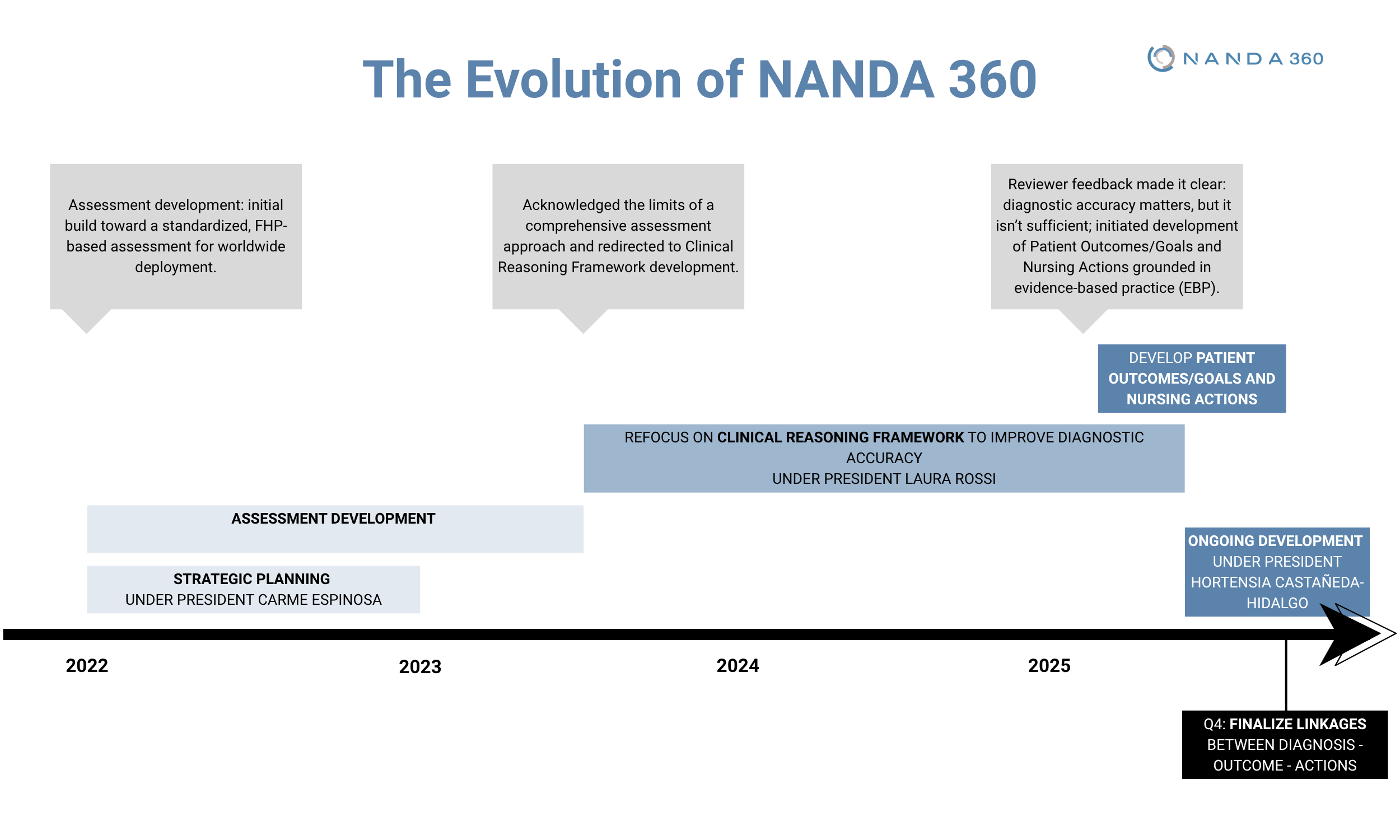
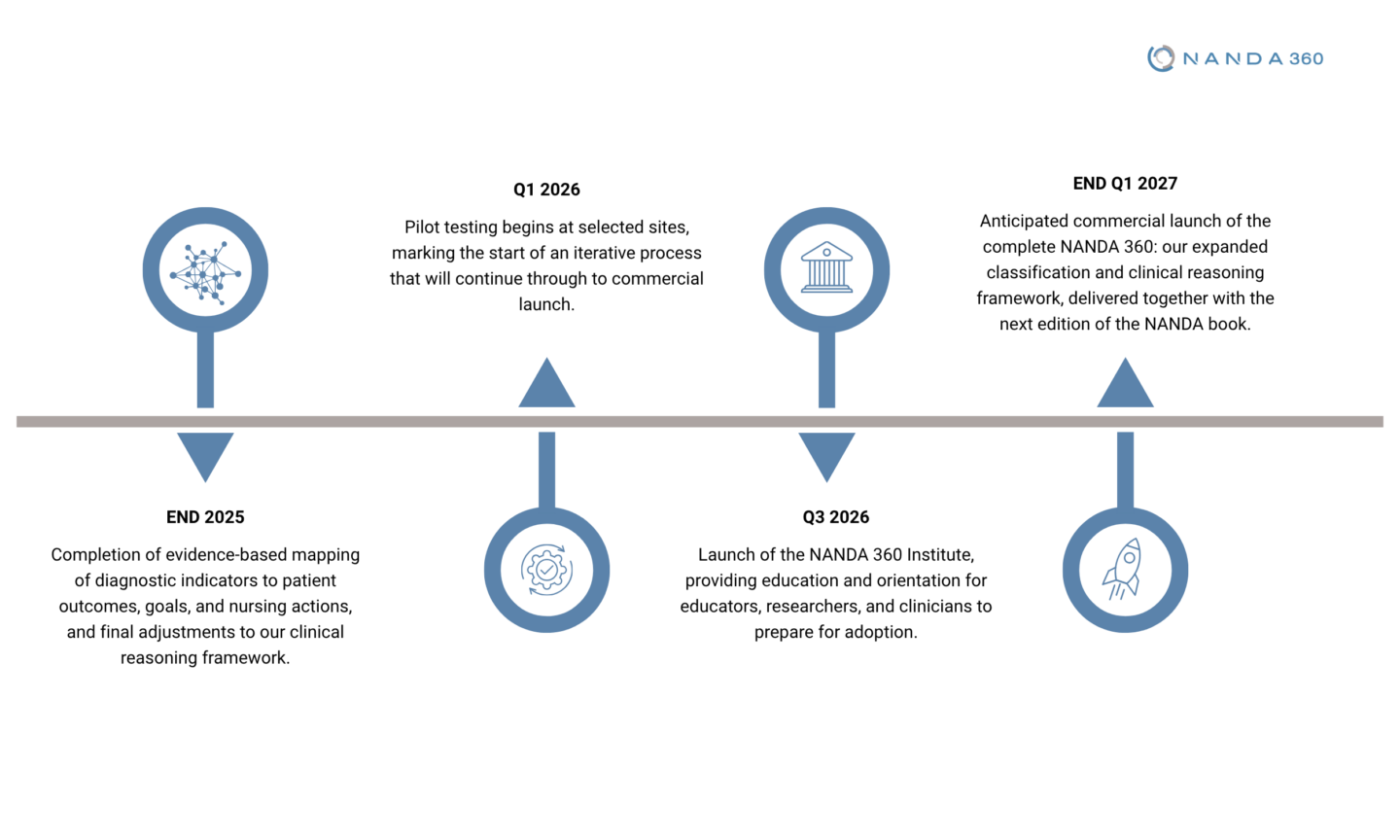
Timeline of NANDA 360 evolution

NANDA 360 builds on the long-standing nursing diagnosis classification and expands it into an integrated nursing knowledge base that:

  • Makes diagnostic reasoning more explicit
  • Links assessment findings directly to diagnoses
  • Links diagnoses to patient goals and measurable outcomes
  • Aligns nursing actions with evidence-based reasoning pathways
  • Creates an assessment-driven, diagnostic-centric approach to clinical reasoning

The result is a unified knowledge base that reflects how nurses actually think and practice.

At its core, NANDA 360 supports the formulation, validation, and clarification of clinical reasoning.

For nurses who are still developing confidence in diagnostic reasoning, it makes the logic of the nursing process visible and teachable. For experienced nurses, it supports hypothesis validation, streamlines decision-making, and provides evidence-informed linkages that can strengthen documentation and care planning. In both cases, NANDA 360 preserves nursing autonomy and professional judgment while supporting clarity, consistency, and individualized care.

Read More Read Less

How NANDA 360 Works

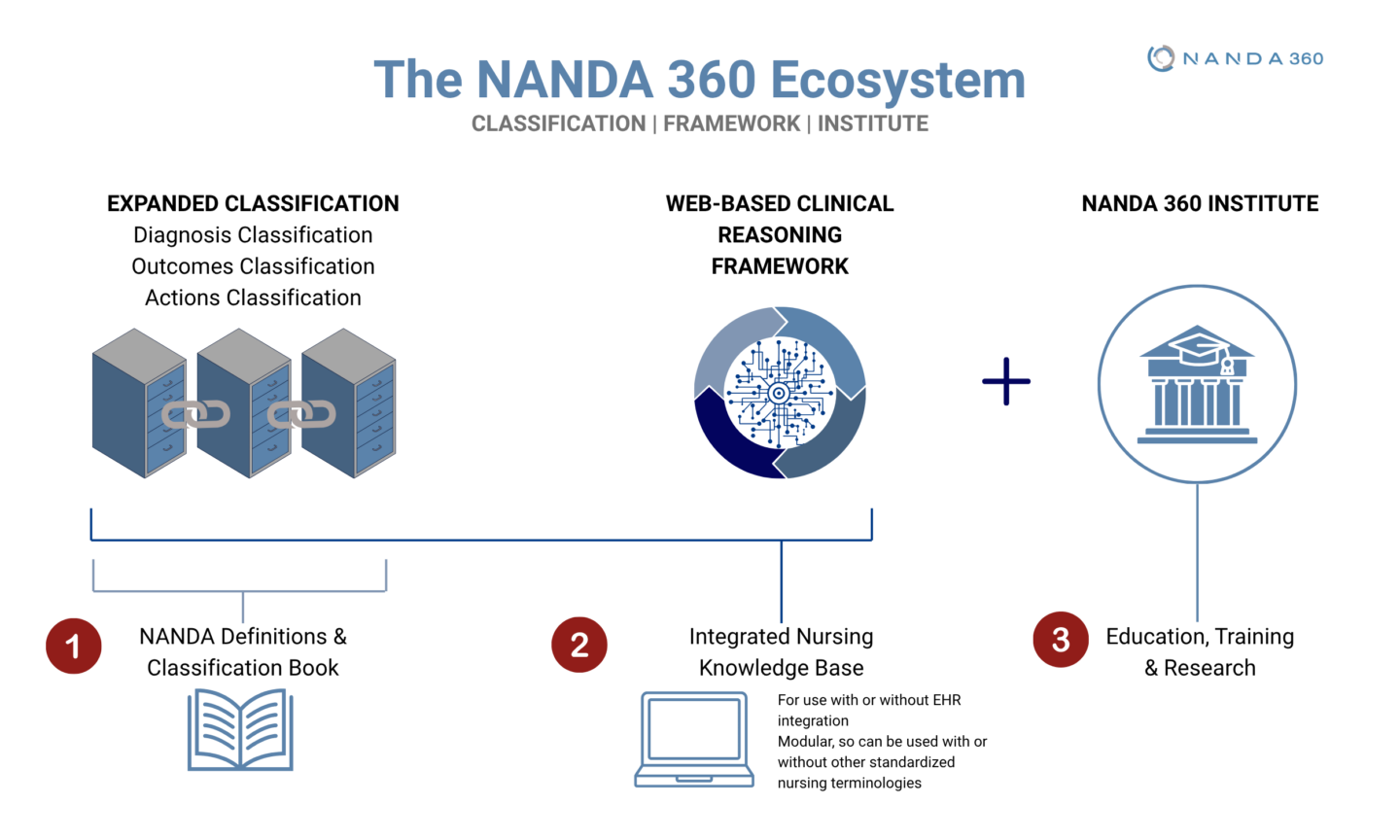
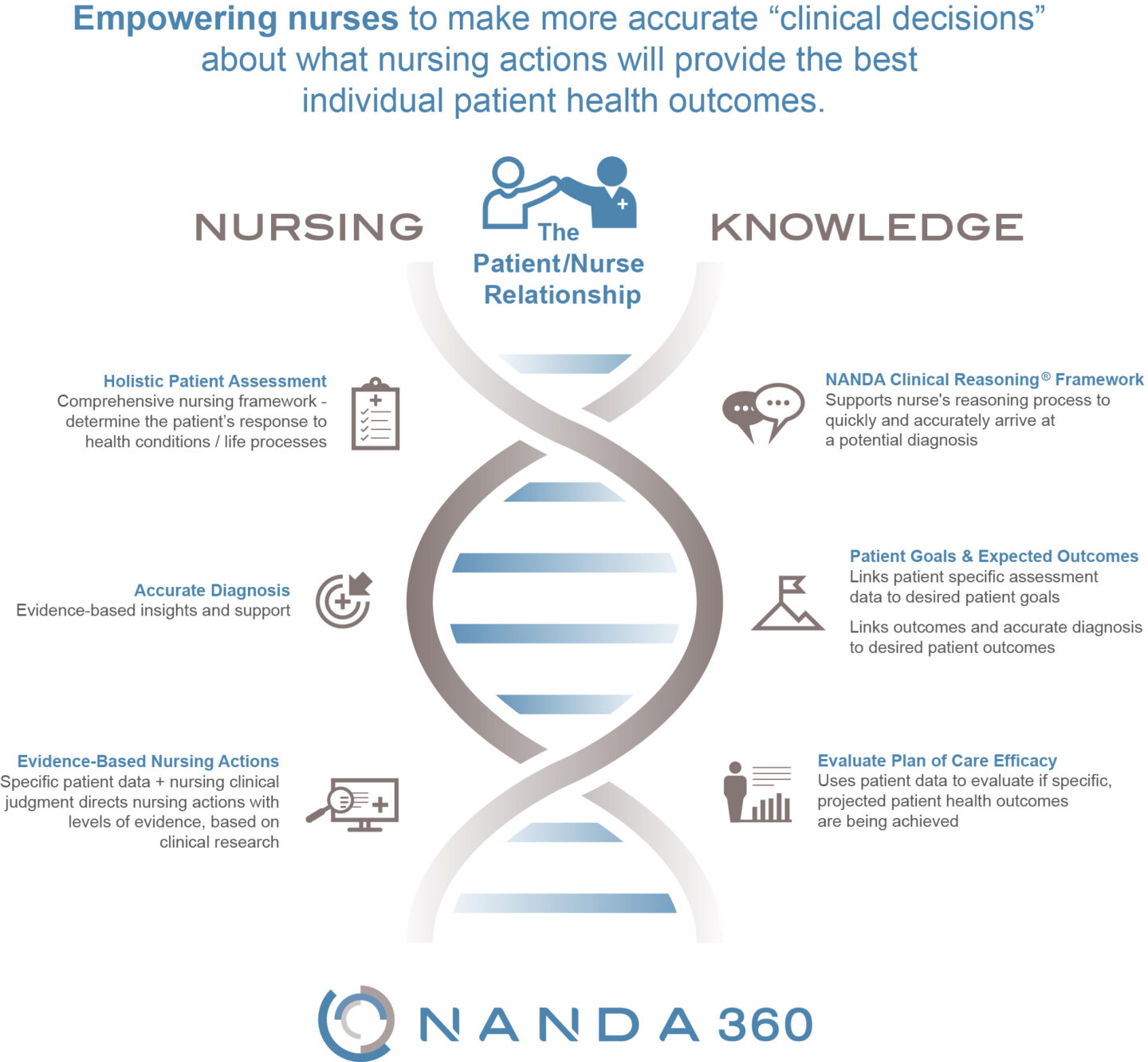
NANDA 360 unifies the nursing process within one integrated classification and clinical reasoning framework.

NANDA 360 infographic

NANDA 360 Serves Every Corner of Nursing

For Nurses in Clinical Practice

NANDA 360

  • Uses evidence-based linkages to unite the entire nursing process
  • Provides a web-based clinical reasoning framework, which offers the ability to streamline documentation by reducing duplicate entries, consolidating screens, and allowing EHR integration so labs, vitals, and screenings can flow directly into the reasoning process
  • Is modular so can be used with other standardized nursing languages
  • Enhances the clinical reasoning process by providing evidence levels, eliminating irrelevant diagnoses, prioritizing critical responses, and providing prompts that guide reasoning without forcing one-size-fits-all plans, all of which equip nurses to make smarter, more efficient, and more confident decisions, amplifying rather than diminishing clinical skill.
  • Preserves nurses’ autonomy and expertise while keeping care individualized and patient- and family-centered.

Created by nurses for nurses, every feature reflects the realities of practice. From the classroom to the bedside, NANDA 360 strengthens collaboration and builds confidence across every level of care.

To learn more about how NANDA 360 can be used in Clinical Practice, please view our blog.

For Educators and Researchers

NANDA 360 supports alignment across education, practice, and research by:

  • Integrating the nursing process within an assessment-driven, diagnosis-centered, expanded classification and clinical reasoning framework
  • Making the logic of clinical reasoning explicit, supporting stepwise development of diagnostic reasoning for learners
  • Supporting hypothesis validation and refinement of clinical judgment for experienced nurses
  •  Providing evidence-based linkages between diagnoses, patient goals and outcomes, and nursing actions to strengthen teaching and practice coherence
  • Evolving as new evidence emerges, enabling continuous refinement of classification linkages
  • Providing a standardized framework within which diagnoses, outcomes, goals, and nursing actions can be organized for coding, retrieval, comparison, and analysis
  • Enabling consistent representation of nursing data suitable for publication, cross-site comparison, and research dissemination
  • Providing structured educational programming (in development), including learning resources, training modalities, and consultation for faculty, clinical educators, researchers, and informatics professionals
  • Creating opportunities for educators and researchers to contribute to the ongoing refinement of the framework

To learn more about how NANDA 360 can be used in Education and Research, please view our blog

For Informatics and Digital Systems

NANDA 360 is designed to support interoperability of nursing data across clinical, educational, and digital environments by:

  • Providing a unified classification for nursing diagnoses, goals, and nursing actions, along with a clinical reasoning framework that can be applied across specialties, sites of care, and health systems
  • Within digital health environments, these structured classifications are commonly referenced as standardized nursing language (SNL). NANDA 360 supports interoperability within this ecosystem through alignment with messaging standards and structured coding frameworks.
  • Supporting structured documentation through standardized classifications, consistent data architecture for storage and retrieval, and coordinated release cycles to support stable digital implementation
  • Enabling integration with electronic health record (EHR) systems so patient data within the EHR can inform clinical reasoning, documentation, and retrieval of nursing data for analysis and research
  • Aligning with HL7 messaging standards and maintaining compatibility with SNOMED CT
  • Ensuring that all data captured through implementation remains securely housed within the adopting organization’s data environment
  • Providing comprehensive technical documentation and implementation guidance to digital license holders to support responsible and consistent deployment

In addition, NANDA International has entered into a five-year collaboration with SNOMED International to support the coordinated use of both organizations’ standards within digital health environments. The collaboration focuses on developing guidance to help healthcare systems implement NANDA classifications and SNOMED CT independently or together while maintaining effective interoperability.

Developed in collaboration with nurse informaticists, NANDA 360 is designed to support practical implementation while preserving the integrity of nursing knowledge.

For Policy Leaders and Health Systems

NANDA 360 supports policy and system-level decision-making by:

  • Providing a standardized framework that enables nursing data to be aggregated and analyzed for quality improvement and policy development
  • Linking evidence-based nursing practice with measurable patient goals and outcomes, supporting visibility of nursing contributions within organizational reporting structures
  • Supporting accreditation and regulatory reporting requirements, including frameworks such as Magnet recognition
  • Providing a standardized framework that enables structured nursing data to be used for oversight, compliance reporting, and internal performance review
  • Enabling the use of comparable nursing data to inform workforce planning, funding models, and health system strategy
  • Supporting cross-site and cross-border comparability through a common classification structure, facilitating international collaboration and alignment with broader health and sustainability initiatives

NANDA 360 also supports operational efficiency by:

  •  Offering a unified licensing model that may reduce duplication of classification purchases
  • Reducing the need for site-specific, non-comparable linkage development
  • Providing leaders with structured criteria to evaluate best practices across settings
  • Delivering comprehensive training and implementation support for faculty, clinical staff, and informaticists to enable responsible adoption

NANDA 360 Institute

Implementation and educational support for NANDA 360 are provided through the NANDA 360 Institute.

Learn More About the NANDA 360 Institute

The Future of Nursing Knowledge

For decades, NANDA-I (now INKA), has built the foundation of nursing knowledge through the development of the nursing diagnosis definitions and classification. That history has brought us to this pivotal moment. With NANDA 360, the nursing process will, for the first time, be supported end-to-end by a single, integrated knowledge base, delivered in coordinated release cycles, across multiple languages, and from one trusted organization. This evolution enables greater consistency worldwide and supports nurses in every setting, from classrooms to clinics, from research institutions to ministries of health.

Below is our rollout plan for NANDA 360.

As implementation continues and feedback from global nursing communities informs refinement, NANDA 360 will continue to evolve in alignment with evidence, practice realities, and educational needs.

Diagnosis remains central.

Clinical reasoning remains foundational.

This is not just the launch of a new system. It is the continuation of our rich history and the beginning of a new chapter; one we cannot write alone. We have been building toward this moment for more than three years, and now we invite you to walk with us as we shape the future of nursing knowledge together.

Read More Read Less

Subscribe to our NANDA 360 Updates Newsletter

Subscribe Today

NANDA 360 FAQ

Does the new framework fit with the European Health Data Initiative?

INKA (formerly, NANDA-I) is currently analyzing the requirements needed to align with the European Health Data Initiative.

Will this replace or integrate with existing NANDA-I diagnoses?

The new framework will be integrated with the existing NANDA-I diagnosis classification.

How are goals and outcomes defined in the new classification?

A nursing goal is the desired and achievable human response of an individual, family, or community, established to guide the care process. It represents an intended future state that directs clinical decision-making and serves as a guide for nursing actions carried out with focus and intentionality within a defined time frame. Moreover, it serves as a reference point for evaluating person progress and the coherence of actions taken throughout the therapeutic process. Goals should reflect realistic, individualized objectives that are compatible with the clinical condition and personal values of the person receiving care.

A nursing outcome is the observed human response of an individual, family, or community resulting from the interaction between the nurse’s intentional action and the person’s clinical context. It reflects the expected or achieved changes in health status relative to the previously established goal and demonstrates the effect of the care provided. The nursing outcome enables the evaluation of whether goals are being met, indicating the effectiveness of nursing actions and serving as a basis for continuing, modifying, or replanning care in accordance with the person’s progress.

How will this change affect institutions already using NANDA diagnoses in curricula, EHRs, or practice?

This will extend these institutions’ abilities to offer one classification that encompasses the entire nursing process. This translates into easier modes of teaching – one consistent taxonomy with three terminologies integrated into an expanded classification – one license, and for those with EHRs, the ability to support nurses with a computer-assisted decision support tool in the form of our clinical reasoning framewo

Who is going to explain in depth NANDA 360? What support will be provided?

INKA is currently developing a series of educational programming which will include a variety of educational modalities and training modalities, and consultation for educators in universities and health systems, clinical practice nurses, as well as those in research and informatics. Stay tuned for more information on this programming, all designed to bring clarity to teaching.

When will the new system be ready for use? What is the rollout process?

Pilot testing will begin Q1 2026; a continuous iterative process will continue with these sites and we anticipate commercial launch of the full classification by the end of Q1 2027. We are announcing now because of the pilot testing that will begin soon, and we wanted people to know this is happening and we are putting this effort into practice now to receive feedback; at the same time, we will continue to add to and refine the NANDA 360 Classification. At that time, educational resources, onboarding materials and comprehensive technical documentation and implementation guides will be provided to digital license holders.

What evidence supports this move to an integrated classification with a unified taxonomy?

The lack of systematic linkages between assessment data and diagnosis, as well as the lack of evidence-based linkages between diagnosis-outcome-nursing interventions, all point to the need for an integrated classification.

What peer-reviewed research or expert panels informed these changes?

We conducted targeted searches of the scientific literature to identify studies offering the highest GRADE level of evidence for actions tailored to each related factor in the context of the specific nursing diagnosis. Most sources were systematic reviews; when other designs were more applicable or more recent (e.g., randomized trials, cohort studies, qualitative syntheses), we used them as well. For every action, we assigned its evidence level based on the strongest GRADE rating found among the studies that directly supported that action. Priority was given to systematic reviews and meta-analyses, however we also included randomized controlled trials, quasi-experimental and observational studies, and, when appropriate for contextualization, qualitative evidence syntheses—particularly when they informed mechanism, acceptability, or implementation. For each related factor, we mapped actions only to studies that explicitly targeted that factor (or a clearly equivalent construct) within the diagnosis context. Actions not supported by factor-specific evidence were excluded or downgraded.

How will the new system ensure consistency across diverse clinical settings and countries?

The ability to have linkages that provide the nurse with clear levels of evidence will support clinical reasoning, and having all of the classification fully coded will enable systems not only to provide standardized terms but also to use those terms to conduct research to demonstrate how nurses impact patient outcomes and organizational outcomes, for example.

How does this change the position of NANDA in relation to other global terminologies like SNOMED CT or ICNP?

NANDA 360 operates within the broader ecosystem of standardized nursing language (SNL), aligning with global terminology standards while maintaining assessment driven, nursing diagnosis-centered integrity.

The new framework will continue to align and even enhance the convergence with other nursing terminologies. A SNOMED CT to NANDA refset is currently in progress to allow SNOMED member countries to leverage the NANDA framework within their SNOMED-enabled electronic health records. This refset will continue to allow NANDA to align with HL7 messaging and other regulatory standards.

How will INKA continue collaborating with other organizations and standards bodies?

INKA will of course continue to ensure that our classification aligns with standard bodies and organizations.

Will NANDA 360 outcomes align with LOINC observations?

In countries where LOINC is in use, NANDA 360 outcomes align with LOINC Observations.

Does this mean INKA (formerly NANDA-I) will not publish a physical book anymore?

We will continue to publish a physical book as well as educational materials. The diagnoses and patient outcome statements will be published in our Definitions & Classification textbook, with linkages available to the full patient goals and nursing actions components of the expanded classification. The expanded classification will be available in both formats (print and web), so regions with limited digital access will still be able to benefit from the linkages. The clinical reasoning framework lives on the web and will be available as a digital version for usage with or without EHRs and as a full clinical reasoning framework or as modular components of the clinical reasoning process.

Can NANDA 360 be used with other standardized nursing languages?

Yes, NANDA 360 print and web-based components are all modular and can be linked to other standardized nursing terminologies. However, linkages to other terminologies are up to the user to create. NANDA 360 was designed to be interoperable with other terminologies but it does not replicate, copy, rebrand, or redistribute that third-party content.

PDFs in Different Languages

Join INKA

Join INKA to help advance nursing knowledge, shape global standards, and strengthen evidence-based practice worldwide.

Join INKA